Revision

Structured learning, retrieval and pupil progress.

✦ Adaptive revision experience

Revision that turns practice into visible progress.

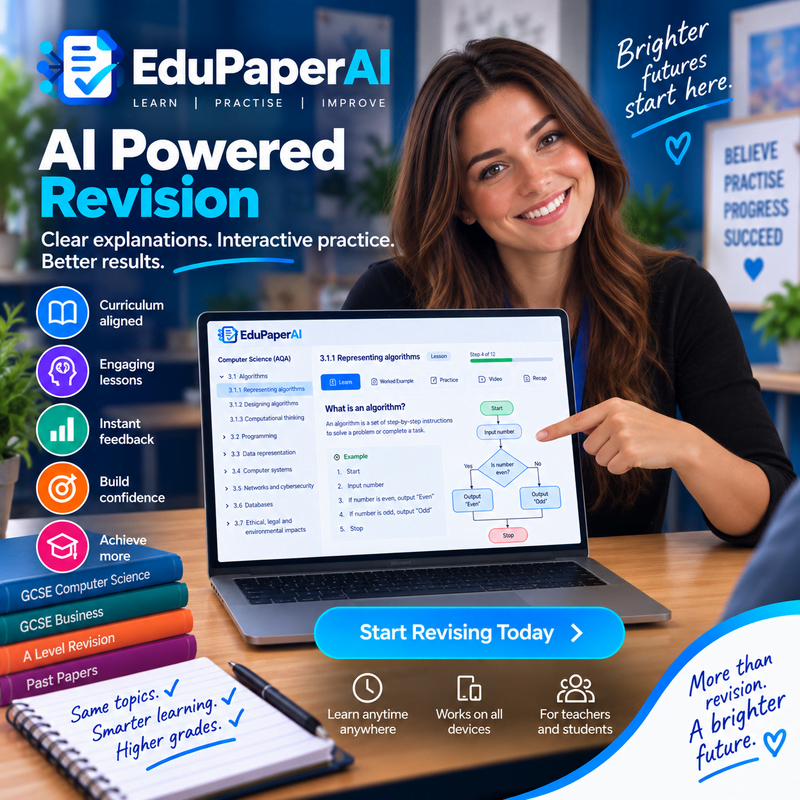
Give pupils a focused place to learn, practise and revisit knowledge using structured activities rather than passive reading alone. EduPaper AI Revision is designed to help teachers provide purposeful independent study while keeping progress visible.

Designed around the way teachers actually work

Practical benefits for everyday assessment, independent learning and departmental improvement.

Active, not passive

Mix explanation, retrieval, multiple choice, code, short answers and exam-style practice so pupils do more than simply read notes.
Built around the curriculum

Organise learning by subject, unit and topic so pupils can move through content in a clear sequence that mirrors classroom teaching.

Progress teachers can use

See completed learning and performance over time, helping teachers identify who is engaging and where further support may be needed.

A clearer independent-learning routine

The revision system is intended to reduce the friction between teaching a topic, setting meaningful follow-up work and seeing whether pupils have understood it. Pupils receive a structured learning journey; teachers gain a stronger evidence trail for intervention and revision planning.

Teach → practise → retrieve
Immediate checks and feedback
Exam-question preparation
Suitable for homework and catch-up

Frequently asked questions

Select a question to reveal the answer. Only one answer is expanded at a time to keep the page easy to scan.

It is the pupil learning and revision area of EduPaper AI. Courses can be organised into subjects, units and topics, with activities that combine teaching content, retrieval, practice and exam preparation.
No. The emphasis is on interaction. Depending on the course, pupils can work through activities such as reading, multiple choice, true/false, fill-the-blank, ordering, matching, code prediction, trace tables, code labs, short answers and exam questions.
Yes. The design is suitable for homework, catch-up, intervention and independent revision. A clear sequence helps pupils know what to do next without relying on a teacher to direct every step.
The revision platform is designed to record progress so teachers can use completion and performance information to support follow-up, intervention and revision planning.
No. It is best used as an extension of high-quality teaching: for reinforcement, retrieval, independent practice, homework, catch-up and preparation for assessments.
Yes. Course content can be structured around a chosen specification so that topics, terminology and progression align with the intended curriculum.
No. The online structure allows pupils to revisit material and continue through activities at an appropriate pace, while the teacher retains oversight of the wider learning sequence.
Yes. The revision renderer can support programming-focused tasks such as code prediction, trace-table activities and code labs where those activities are appropriate to the course.
Teachers can use progress and performance evidence to spot incomplete learning, weaker topics or pupils who may benefit from additional practice, then target intervention more precisely.
The learner experience is designed for modern browsers and responsive layouts, although activities involving larger diagrams or substantial coding are naturally easier on a larger screen.